|
There isn't a Biggest Story for Today, yet.
|
| Thursday, May 19 | | · | |
| Monday, April 25 | | · | |
| Friday, April 22 | | · | Denying Discrimination: Clintonian Political Calculus and the Culture of Hooey |
| Wednesday, December 09 | | · | The Religious Element of Terrorism |
| Sunday, November 29 | | · | |
| Saturday, November 21 | | · | The Paris Attacks and the White Lives Matter Movement |
| Sunday, September 27 | | · | Freedom Rider: Ahmed Mohamed and Abdulrahman al-Awlaki |
| Monday, August 10 | | · | |
| Saturday, June 20 | | · | America Prosecutes the World |
| Wednesday, April 29 | | · | Skip Gates and Sony Exposed by Wikileaks |
Older Articles
|
|  |
|
South America: U.S. Uses International Finance System to Strangle Venezuelan Economy
|
|
Regime Change Via Sanctions? U.S. Uses International Finance System to Strangle Venezuelan Economy
March 14, 2019 - democracynow.org
Venezuelan officials say power will be largely restored in the country today after a week-long blackout across much of the country. The cause of the blackout remains in dispute. The United States blamed it on years of neglect of the Venezuelan energy system, but Venezuelan President Nicolás Maduro accused the U.S. military of launching a “cyberattack against the electrical, telecommunication and internet systems.” The blackout comes amid a growing political crisis in Venezuela as U.S.-backed opposition groups attempt to topple Maduro’s government. On Monday, the United States announced it was withdrawing remaining diplomatic staff from its embassy in Caracas. We speak with Mark Weisbrot, co-director of the Center for Economic and Policy Research and president of Just Foreign Policy. His latest piece for The New Republic is headlined “The Reality Behind Trump’s Coalition for Regime Change in Venezuela.”
Transcript
This is a rush transcript. Copy may not be in its final form.
NERMEEN SHAIKH: Venezuelan officials are saying power will largely be restored by today, after a week-long blackout across much of the country. The cause of the blackout remains in dispute. The United States blamed it on years of neglect of the Venezuelan energy system, but Venezuelan President Nicolás Maduro accused the U.S. military of launching a, quote, “cyberattack against the electrical, telecommunication and internet systems.” The blackout comes amid a growing political crisis in Venezuela as U.S.-backed opposition groups attempt to topple Maduro’s government. It’s been nearly two months since opposition leader Juan Guaidó declared himself to be president with the backing of the United States.
|
|
African Diaspora: How the U.S. Is Strangling Haiti as It Attempts Regime Change in Venezuela
|
|
Their message is simple: if you won't let us breathe, we won't let you breathe, and if you suffocate Venezuela, you suffocate us
By Vijay Prashad
February 19, 2019 - commondreams.org
Last year, in October, Haitians followed two Twitter hashtags that went viral–#PetrocaribeChallenge and #KotKobPetwoKaribea. If you are not Haitian and do not follow Haitian politics carefully, you can be forgiven for not noticing this development. The complaint on Twitter–and soon on the streets–was simple: what has happened to the billions of U.S. dollars that was in the Venezuelan-financed Petrocaribe program?
In 2005, when oil prices began to creep upwards and when the Bolivarian socialists led by Hugo Chávez were at their peak, 14 countries from the Caribbean met in Puerto La Cruz, Venezuela, to launch the Petrocaribe scheme. The idea was elegant. Venezuela, with one of the world's largest oil reserves, would sell oil to the struggling Caribbean islands through a very lucrative deal. Part of the oil price was paid up front, and the rest was to be paid back over the years at a ridiculously low interest rate (1 percent).
|

By Eric Draitser
January 30, 2019 - counterpunch.org
The US-sponsored coup in Venezuela, still ongoing as I write, is the latest chapter in the long and bloody history of US imperialism in Latin America. This basic fact, understood by most across the left of the political spectrum – including even the chattering liberal class which acknowledges this truth only with the passage of time and never in the moment – must undergird any analysis of the situation in Venezuela today. That is to say, the country is being targeted by the Yanqui Empire.
This point is, or at least should be, indisputable irrespective of one’s opinions of Venezuelan President Maduro, the Socialist Party (PSUV), or the progress of the Bolivarian Revolution. Imperialism, and its neocolonial manifestation in the 21st Century, is there to pick clean the bones of the Bolivarian dream and return Venezuela to the role of subservient asset, an oil-soaked proxy state ruled by a right-wing satrap eager to please the colonial lords of capital.
|
|
U.S.A.: Martial Law By Other Means: Corporate Strangulation of Dissent
|
|
By Glen Ford, BAR executive editor
August 09, 2018 - blackagendareport.com
The ‘hate speech’ trick, in practice, rewards Black people’s occupiers and abusers (the police) and renders voices of protest illegitimate and mute.”
The people that rule the United States are in the third year of a frenzy to blame Russia and its “trolls,” “dupes,” and witting or unwitting “colluders” – including a sitting president – for racial conflicts, eroding respect for public institutions and a general social breakdown in the nation. “We are at war!” they scream, incessantly, and in a thousand well-placed voices. The relentless barrage of war-talk crowds out all other subjects in the corporate media -- the Omnipresent Voice of Oligarchy -- including the actual warswaged all across the globe by the U.S. and its shrinking gaggle of allies.
By now, 65 percent of Americans -- if asked -- tell pollsters they think Russia “interfered” in the 2016 elections. According to an NBC/Wall Street Journal poll released late last month, 41 percent believe that whatever the Russians did had some effect on the election, and 30 percent think Hillary Clinton would be president if the Russians had not interfered.
|
|
African Diaspora: The British Royal Wedding, Feelgoodism and the Colonial Jumbie
|
|
By Tyehimba Salandy
May 20, 2018
Ten years ago, British ‘royalty’, Prince Charles and his wife Camilla visited the Caribbean and locals prostrated before them. Local leaders made arrangements for them to play the Steelpan and the sacred Rastafarian Nyabinghi drums. Leslie from Africaspeaks.com wrote an insightful article titled Royal Visit Highlights Lingering Colonialism that brought attention to the dynamics of colonialism in this visit. This article is as relevant today as it was ten years ago when it was written, given the celebratory eruptions at the wedding of British monarch Prince Harry and his bride Meghan Markle. Yet the region is poorer today for elevating fake royalty to dizzying heights of reverence while neglecting the royalty inherent in resistant Caribbean voices who have worked hard at improving Caribbean societies.
While many people gush at royalty and the “power of love”, for people of the Caribbean and wider global south, who are still faced with the structures of British coloniality imbedded deeply in our society and the world we live in, it is an opportunity to reflect on these issues.
|
|
African Diaspora: Zimbabwe Open for Business, Code for International Finance Capitalism
|
|

By Netfa Freeman
March 15, 2018 - blackagendareport.com
“Zimbabwe’s new president offered an open invitation to international capital investment and latecomers for Zimbabwe’s trek down the neoliberal development road.”
Over the last four months, peddling the mantra “Zimbabwe is open for business,” the country’s new president in cahoots with the Western press has been whitewashing a military coup into a popular, peaceful revolution that brought from exile a benevolent leader and placed him in power on an interim basis until elections. Omitted from the portrayal of the March 11, 2018 op-ed, “We Are Bringing About the New Zimbabwe ,” published in the New York Times and by-lined to Zimbabwe’s sitting president, Emmerson Mnangagwa, are all the maneuvers selling out the country’s political independence. Given reports of what happened to some of ZANU-PF’s G40 faction, including the killing of a bodyguard, and jailing with allegations of torture from November 14, 2017, until at least Robert Mugabe resigned as president a week later, the accounts in Mnangagwa’s op-ed are a pretty audacious rewriting of history.
|
By Ramzy Baroud
January 12, 2018
There is a real – but largely concealed – war which is taking place throughout the African continent. It involves the United States, an invigorated Russia and a rising China. The outcome of the war is likely to define the future of the continent and its global outlook.
It is easy to pin the blame on US President Donald Trump, his erratic agenda and impulsive statements. But the truth is, the current US military expansion in Africa is just another step in the wrong direction. It is part of a strategy that had been implemented a decade ago, during the administration of President George W. Bush, and actively pursued by President Barack Obama.
In 2007, under the pretext of the ‘war on terror’, the US consolidated its various military operations in Africa to establish the United States Africa Command (AFRICOM). With a starting budget of half a billion dollars, AFRICOM was supposedly launched to engage with African countries in terms of diplomacy and aid. But, over the course of the last 10 years, AFRICOM has been transformed into a central command for military incursions and interventions.
|
By Netfa Freeman
November 29, 2017 - blackagendareport.com
“The West, led by Britain and the U.S., have been engaged in a regime policy against the Southern African nation for the last 18 years.”
Reasons for examining what is happening in Zimbabwe are many but few to none can be found in accounts by major news media or from liberal progressive pundits. Such accounts are busy reinforcing the over simplified and misinforming narrative that forcing out former 93 year-old president Robert Mugabe marks the end of 37 years of brutal dictatorship that has driven the country into economic disaster.
The over simplified version being fed to the general public is that everything kicked off after Mugabe fired a disagreeable vice-President. Zimbabwe is to be seen as just another African country with a long reigning dictator who presides over the repression and impoverishment of his own people who really are unable to govern themselves without the aid of the benevolent West.
|
By Gregory Elich
November 21, 2017 - gregoryelich.org
Long-roiling factional conflict within Zimbabwe’s ruling ZANU-PF political party exploded last week in a military coup that quickly seized control of the government and state media. The coup was led by Commander of Zimbabwe Defense Forces Constantino Chiwenga, who is closely aligned with former vice president Emmerson Mnangagwa.
Emboldened by President Robert Mugabe’s declining mental sharpness and physical health in recent years, Mnangagwa actively maneuvered to ensure that he would succeed the president. Mnangagwa served as one of Zimbabwe’s two vice presidents. From that position, he and his supporters, known as Team Lacoste, became embroiled in a bitter struggle with younger party members who coalesced around Secretary of Women’s Affairs Grace Mugabe, wife of the president, and whose group was known as Generation 40, or G40.
|
By Noel Kalicharan
April 22, 2017
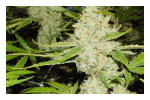
The "war on marijuana" has been waged for close to one hundred years, cost trillions of dollars and hundreds of thousands of lives, made criminals out of millions of otherwise law-abiding persons, denied life-saving medicine to millions more, without making the smallest dent in its availability.
Three men orchestrated the war: William Randolph Hearst (newspaper magnate), Andrew Mellon (former Treasury Secretary and one of America’s wealthiest bankers and industrialists) and Harry Anslinger (appointed by his uncle-in-law Mellon to be the first Commissioner of the Treasury Department’s newly reorganized Federal Bureau of Narcotics and Dangerous Drugs, forerunner to the Drug Enforcement Agency). Throw in the DuPont Chemical Company, whose main financier was Mellon Bank, and you have the prime players.
|
By Leanna Ganga
Trinidad and Tobago
April 18, 2017
Imagine a society where all drugs are legal and persons can openly purchase any drug of their choice from licensed and regulated distributors, just like they already purchase cigarettes and alcohol.
One may think of such a society in a state of what sociologists call anomie and deviance, with lots of intoxicated people committing criminal acts and the majority of citizens being addicts. This thinking, however, would be inaccurate.
Empirical evidence demonstrates human societies have always had cultures of intoxication and used mild to strong hallucinogens. For example, from ancient civilizations to pre-20th century USA, and even pre-1960 Trinidad, the evidence shows that marijuana/ganja was used for recreational, medicinal, religious and other purposes. Dr. Peter Hanoomansingh, for example, documented a time in Trinidad and Tobago when you could still buy ganja over the counter. In these eras, there is strong evidence that we did not have societies plagued by violence, corruption and other drug-related problems, which many researchers indicate is a direct consequence of the war on drugs.
|
By Dr. Selwyn R. Cudjoe
October 09, 2016
In academic and political lectures, when I refer to the negative psychological and economic impact slavery has had on black people, my questioners usually retort: "You have to bring up slavery again?"
The same people who object to my bringing up slavery's impact upon black people have no objections when Jews urge their people: "Never forget!"
This raises the question: Why should black people forget about slavery when Haiti, well into the 20th century, paid reparations to France for having fought for and won their freedom? In 1825, threatening an invasion, France sent a flotilla to Haiti to compel Haitians to pay a ransom of 150 million gold francs for their freedom. It was reduced subsequently to 90 million gold francs or US$40 billion in today's currency. In 2010, 90 leading academics, authors, and human rights activists, in an open letter to president Nicolas Sarkozy, "urged the French government to pay Haiti for the 90 million gold francs Haitians were forced to pay France for their independence" (London, Guardian, 16 August 2010).
|
Made Man in a Blue Vest: Deray McKesson Is Debutante At Aspen One-Percenters Coming Out Party
By Bruce A. Dixon
July 11, 2016 - blackagendareport.com
It's been a good spring and summer so far for Teach For America alum Deray McKesson. After raising a ton of out of town money the dude in the blue vest finished sixth in the Baltimore mayoral election with a mere 2% of the vote. He was promptly awarded a six figure yearly salary as “interim chief of human capital,” the current term of art for personnel department directors. And last weekend, he was one of the headliners at the annual Aspen Ideas Festival.
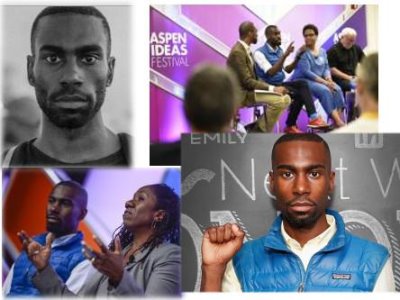
Made Man in a Blue Vest: Deray McKesson
|
|
African Diaspora: U.S. Sets Stage for Libya-Like Regime Change in Eritrea, “Africa’s Cuba”
|
|
By Glen Ford
June 18, 2016 - blackagendareport.com
“Eritrea’s fierce independence has put it in imperialism’s crosshairs.”
The United States is methodically setting the stage for a so-called “humanitarian” military intervention against the small northeast African nation of Eritrea, under legal pretexts much like those used to justify NATO’s war of regime change against Libya, in 2011. As in Libya, the U.S. has hijacked the United Nations human rights apparatus to claim a “responsibility to protect” (R2P) Eritrea’s citizens from alleged abuses by their own government. War and regime change are the intended result.
Washington engineered UN sanctions against Eritrea, beginning in 2009, on the patently bogus charge that Eritrea’s determinedly secular government provided “political, financial and logistical support” to Islamist Shabaab fighters in Somalia. Islamic jihadism is anathema to Eritrea, whose population of six million on the shores of the Red Sea is about evenly divided between Muslims and Christians. But few people in the United States knew Eritrea existed, much less its secular revolutionary history and politics. The lies stuck, as did the sanctions, even after the UN Human Rights Council conceded there was no further evidence of Eritrean aid to the Shabaab.
|

By Abby Zimet
June 06, 2016 - commondreams.org
A nod to the great Muhammad Ali, dead at 74, a brave black man at a difficult time who "just wanted to be free," who never knew his place and refused to be afraid when others tried to put him in it, who insisted to the world of power that first honored and then rejected him that "I don't have to be what you want me to be," who at the height of his fame and riches declared "Goddamn the White Man's money" in the name of principle, who refused to join a racist unjust war, connected the dots of white oppression around the world and proclaimed, "The real enemy of my people is here."
Though so many remember him for unprecedented grit and grace in the boxing ring, Ali himself chose again and again to measure his own worth in the world beyond his bloody sport. “Boxing is nothing, just satisfying to some bloodthirsty people," he said near the end of his reign. "I’m no longer a Cassius Clay, a Negro from Kentucky. I belong to the world, the black world." The final irony of Ali's political heroism, notes Dave Zirin, is that he was unequivocally hailed as a national icon only after he lost his fearless voice.
|
| |
|
There is a problem right now with this block.
|
|